 University of North Texas



Cave Paintings
Artist Erika Jaeggli ('22 M.F.A.) finds inspiration in the deep earth.
July 8, 2025
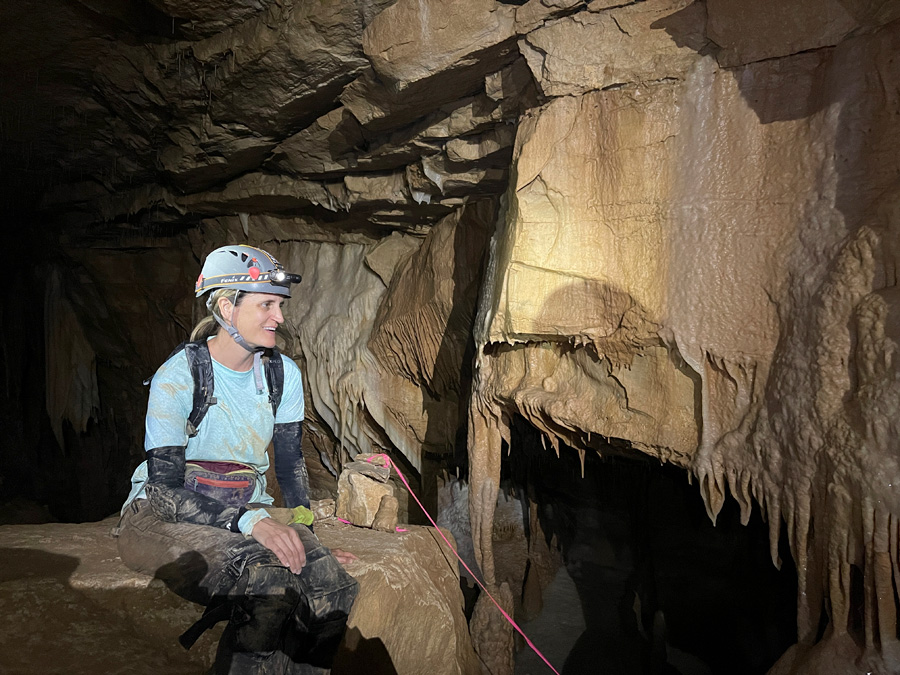
Erika Jaeggli ('22 M.F.A.)
Erika Jaeggli ('22 M.F.A.) often has to crawl through tight, dark tunnels -- and mud -- to create her art.
"I absolutely fell in love with the experience of being inside a cave and the idea of seeing the landscape from inside and going into the belly of the earth."
Once she's found the perfect angle, Jaeggli gets out her camera and, if she's able, her pencil and sketch pad.
The Dallas-based artist had long painted landscapes, but after her time in graduate school at UNT's College of Visual Arts and Design, caves have served as her subject. She's created works that have drawn attention from several galleries, a residency in France and, this fall, a residency at Carlsbad Caverns National Park in New Mexico.
"I love this feeling of exploring what's next, what's behind this corner, and the physicality of it -- where you are on your hands and knees and back all the time. It's like feeling the earth."
'Seek What You Shall Find'
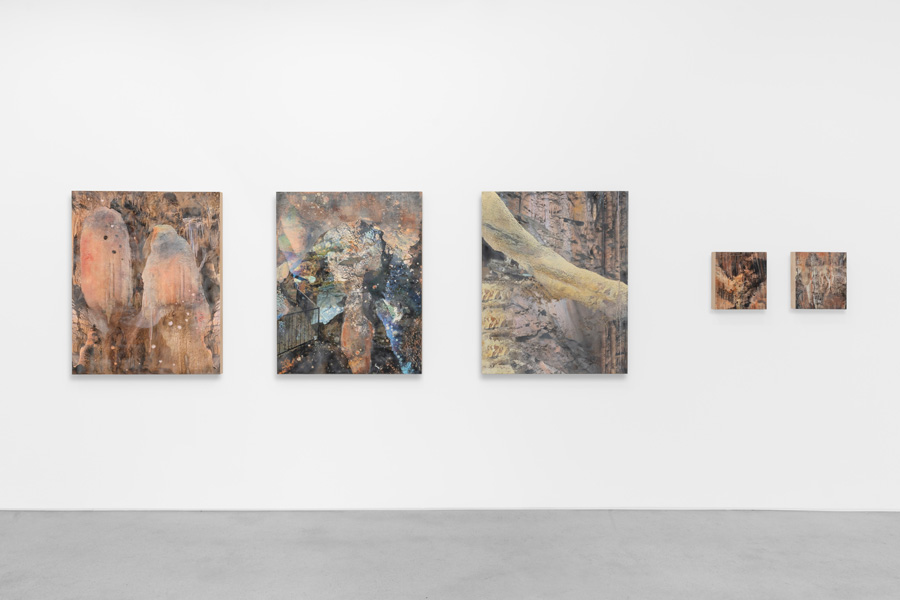
Erika Jaeggli artwork
"I never thought that I would be painting caves," Jaeggli says.
Around 2019, Jaeggli was looking to attend graduate school and was impressed by UNT's acclaimed art faculty and state-of-the-art building.
She already earned degrees in art history from Columbia University and interactive technology from New York University, but working in video and web design, she wanted to focus more on her painting.
"I was doing a lot with the relationship between the body and the landscape," she says. "When I got to graduate school, I was into the idea of caves as this conceptual thought experiment -- entering the cave you fear is how you seek enlightenment. And I wanted to completely disrupt my entire practice and make huge changes. So, it started out as this idea of 'Just go into the cave and seek what you shall find within the cave.'"
Then Matthew Bourbon, professor of studio art and her committee chair, encouraged her to travel to explore her subjects.
"He was like, 'You're making all this work about caves. You should probably go into a cave or two.'"
'Convergence of Cave and Art'
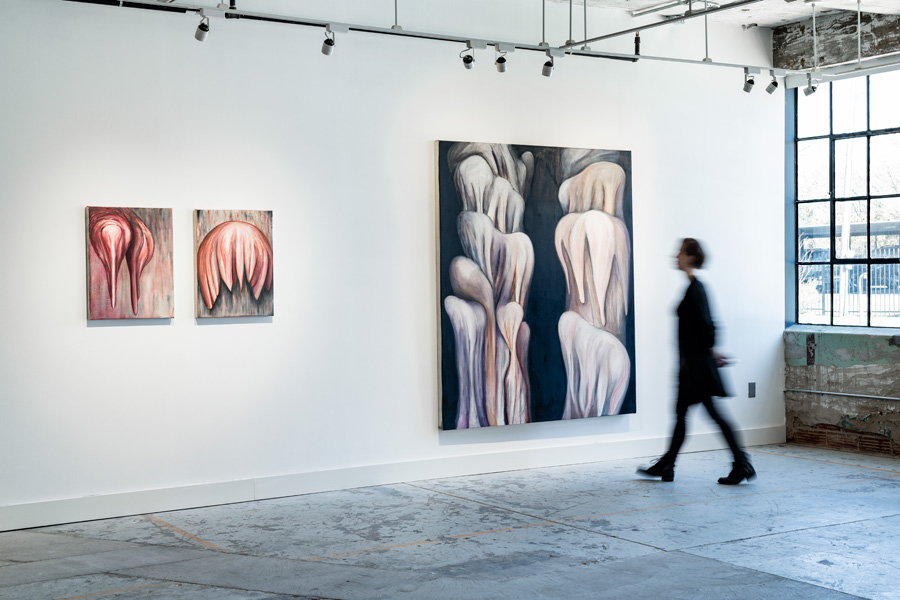
Exhibition at Giant Runt Gallery. Photo by Stephanie Gerhart
Jaeggli took his advice.
She received a grant from the Dallas Museum of Art that funded her travels to seven caves around Texas.
While most people tour commercial caves, which provide pathways and lighting, she goes to wild caves, which are undeveloped, so visitors may have to crawl through mud and water with only a headlamp to light the shallow air space.
"I'm not interested in taking beautiful photos or making photorealistic representations of the caves. My goal is to convey an experience that I've had in the cave."
Once she comes out, she'll take copious notes. She'll journal and envision drawings in her head.
At Cave Without a Name in Boerne, the owners let her stay for four hours drawing.
For Carlsbad Caverns National Park, she only could bring a tiny sketchbook, so she drew along the way.
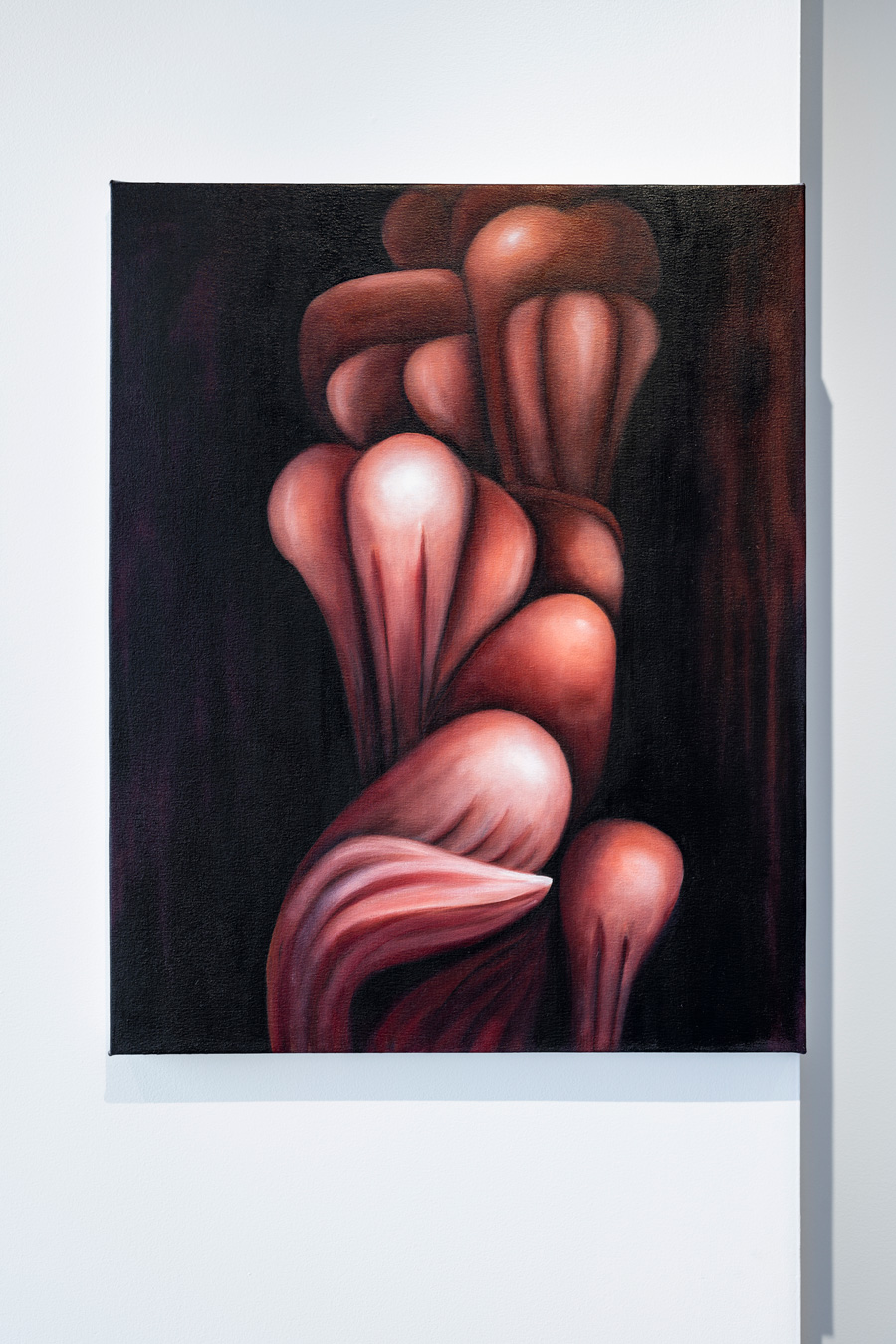
Exhibition at Giant Runt Gallery. Photo by Stephanie Gerhart
During a residency in France this May, she visited seven caves in four days. She traveled to Lascaux, which has a replica of the original cave with paintings of horses, mammoths and bison made 17,000 years ago and five caves that allow limited visitors to view the original cave paintings.
The paintings are deep within the cave, so the Paleolithic artists would have crawled at times through three-foot-high spaces to reach them.
"That was one of the most profound experiences I've ever had," she says. "You're standing in the same place that your prehistoric ancestor painted this stuff, and it's incredible how skillful the drawings were."
By the end of the residency, she completed 18 paintings, all rolled up in loose canvases.
Jaeggli, who teaches classes at various colleges in the Dallas-Fort Worth area, will serve as artist in residence at Carlsbad Caverns National Park in New Mexico this fall. She'll spend two weeks there as opposed to the typical single afternoon she usually gets to study a cave.
"I'm thrilled because this one will really be the convergence of cave and art. I'm excited to see what recurring themes come up in my head."
She feels her art is unique since she's going inside the earth.
"It's like an untapped subject matter within art," she says. "It's taking a different viewpoint of the land."