- 09/29/2025 03:38:25 PMResearchOrganoid ResearchProfessor Adam Yang’s work could lead to breakthroughs in heart treatment testing.Professor Adam Yang’s work could lead to breakthroughs in heart treatment testing.
![]()
 UNT Newsstory
Adam Yang
UNT researchers are making groundbreaking discoveries that can lead to safer and more accurate heart treatment testing and open the door to more collaboration between engineers and biomedical researchers.
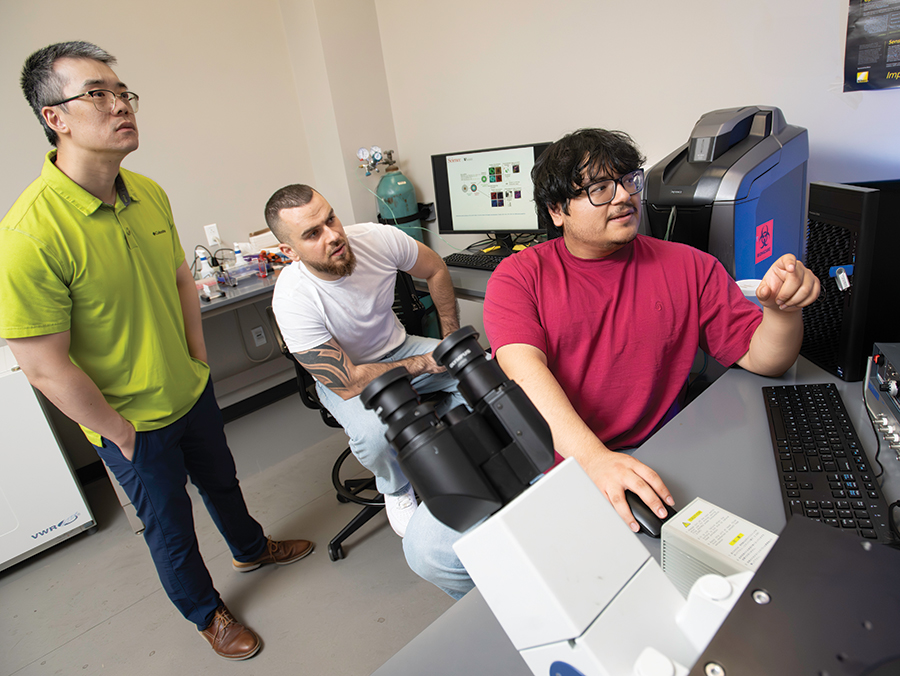
Bioengineering assistant professor Adam Yang and his team are creating tiny lab-grown artificial organs called organoids. The breakthrough for these organoids is that they're vascularized, meaning they feature a blood vessel network capable of mimicking a human network.
The project has now been published in Science, one of the world's top academic journals. Yang's team has already moved on to the next phase of research, making the organoids even more like a human heart.
UNT Newsstory
Adam Yang
UNT researchers are making groundbreaking discoveries that can lead to safer and more accurate heart treatment testing and open the door to more collaboration between engineers and biomedical researchers.
Bioengineering assistant professor Adam Yang and his team are creating tiny lab-grown artificial organs called organoids. The breakthrough for these organoids is that they're vascularized, meaning they feature a blood vessel network capable of mimicking a human network.
The project has now been published in Science, one of the world's top academic journals. Yang's team has already moved on to the next phase of research, making the organoids even more like a human heart.