- 03/27/2020 12:00:00 AMPreventing Pipeline LeaksPhysics professor creates a virtual organic chemistry laboratory inside a supercomputer.
 Campus NewsDepartment of PhysicsResearchstory
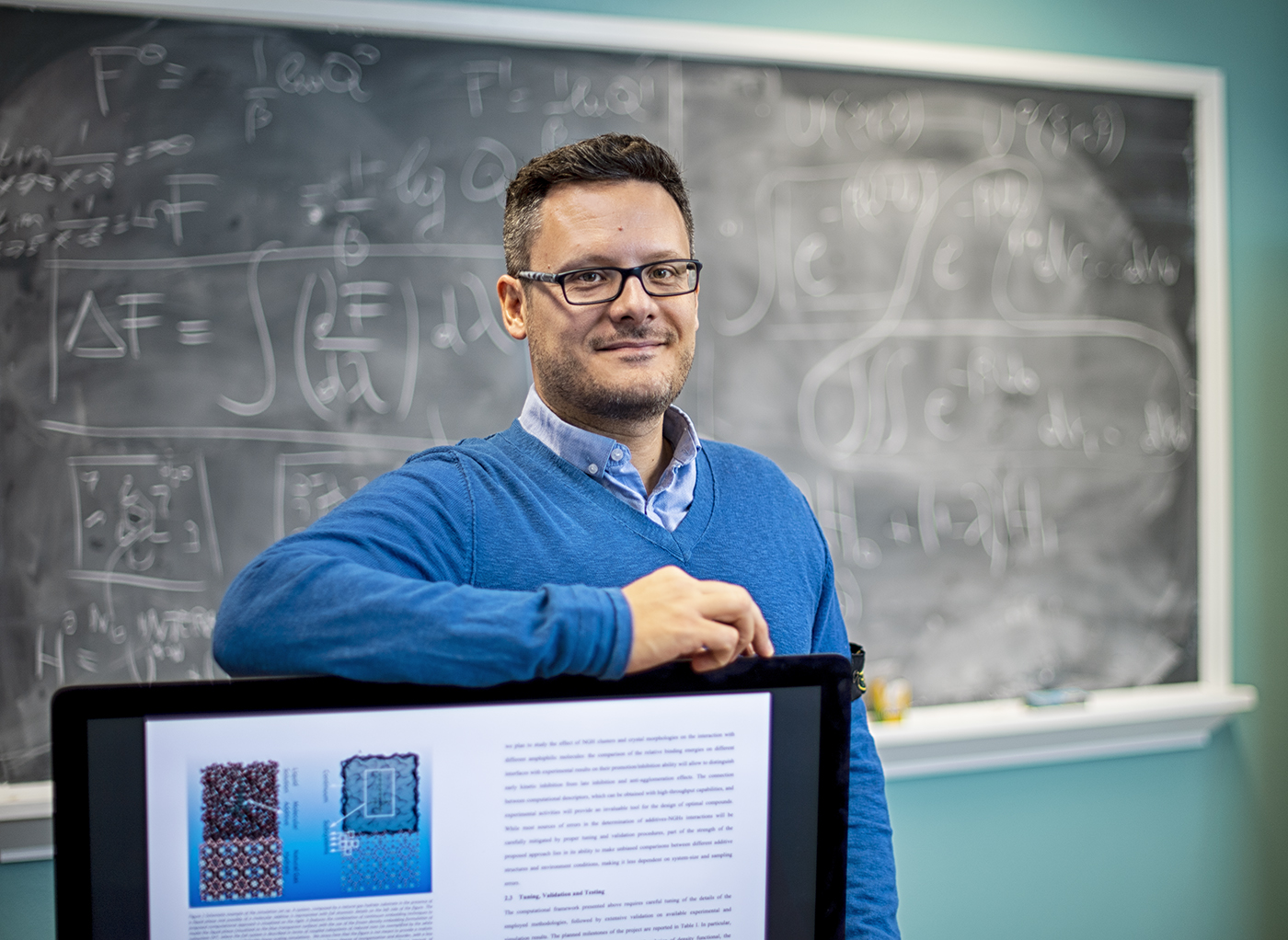
Oliviero Andreussi
Complex organic chemistry experiments often take days or weeks to conduct in a laboratory, but Oliviero Andreussi -- an assistant professor in UNT's Department of Physics -- has created a virtual organic chemistry laboratory inside a supercomputer to conduct these same experiments in a matter of minutes.
By using computational chemistry, Andreussi will begin cycling through scientific databases listing thousands of organic molecules to determine the various effects of different compounds on the production or suppression of natural gas hydrates.
"Natural gas hydrates are crystalline structures made of gas molecules trapped in a cage of water molecules," Andreussi says. "The increase and decrease of the production of these natural gas hydrates could be used to do everything from preventing undersea oil pipeline breaks to storing greenhouse gases."
Campus NewsDepartment of PhysicsResearchstory
Oliviero Andreussi
Complex organic chemistry experiments often take days or weeks to conduct in a laboratory, but Oliviero Andreussi -- an assistant professor in UNT's Department of Physics -- has created a virtual organic chemistry laboratory inside a supercomputer to conduct these same experiments in a matter of minutes.
By using computational chemistry, Andreussi will begin cycling through scientific databases listing thousands of organic molecules to determine the various effects of different compounds on the production or suppression of natural gas hydrates.
"Natural gas hydrates are crystalline structures made of gas molecules trapped in a cage of water molecules," Andreussi says. "The increase and decrease of the production of these natural gas hydrates could be used to do everything from preventing undersea oil pipeline breaks to storing greenhouse gases."