- 03/22/2019 12:00:00 AMImproving AlfalfaA team of UNT scientists has developed ways to limit the plant's environmental footprint.
 Campus NewsUNT NewsCollege of Arts & Sciences, Department of Biological Sciencesstory
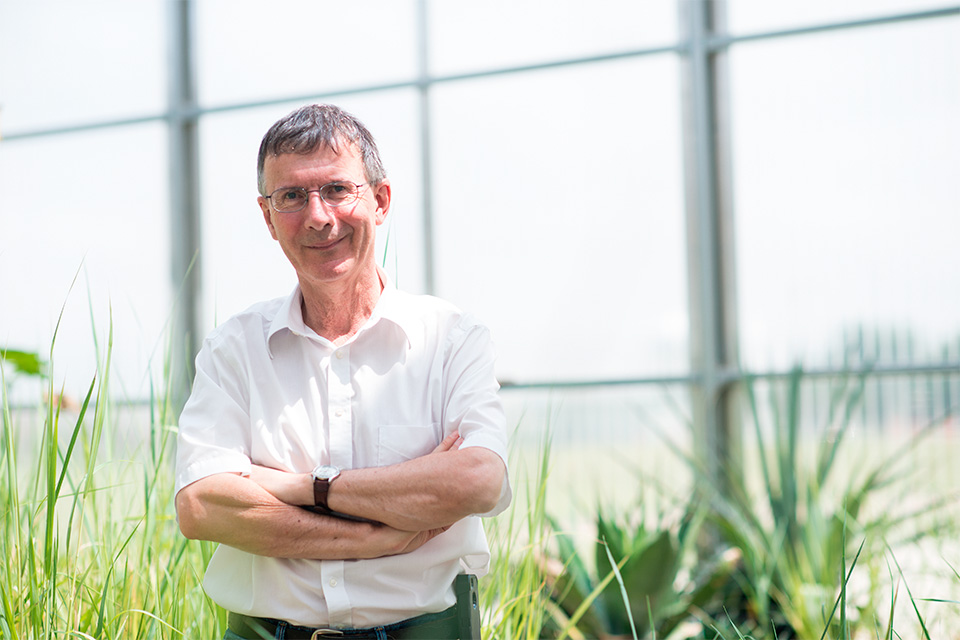
College of Science professor, National Academy member and Royal Society fellow Richard Dixon is leading a team at UNT's BioDiscovery Institute that has found ways to limit the environmental footprint of alfalfa.
A team at UNT's BioDiscovery Institute, led by College of Science professor, National Academy member and Royal Society fellow Richard Dixon, has developed ways for the common alfalfa plant to produce types of tannin that will allow for better digestion by sheep and cattle with less release of environmentally unfriendly greenhouse gases. One of the properties of tannin is that it can bind to proteins and, in the case of livestock, allow the proteins to last longer during the process of digestion, with less release of methane.
The team, whose findings were published in Nature Plants in November, has discovered ways to alter the composition and size of tannins in alfalfa and related plants through genetic engineering.
Campus NewsUNT NewsCollege of Arts & Sciences, Department of Biological Sciencesstory
College of Science professor, National Academy member and Royal Society fellow Richard Dixon is leading a team at UNT's BioDiscovery Institute that has found ways to limit the environmental footprint of alfalfa.
A team at UNT's BioDiscovery Institute, led by College of Science professor, National Academy member and Royal Society fellow Richard Dixon, has developed ways for the common alfalfa plant to produce types of tannin that will allow for better digestion by sheep and cattle with less release of environmentally unfriendly greenhouse gases. One of the properties of tannin is that it can bind to proteins and, in the case of livestock, allow the proteins to last longer during the process of digestion, with less release of methane.
The team, whose findings were published in Nature Plants in November, has discovered ways to alter the composition and size of tannins in alfalfa and related plants through genetic engineering.